

Skyfinding After Dark


Turn an overwhelming sky into a short sequence of recognisable directions, shapes and star hops.
Take this guide on its own, or follow the complete library from first bearings to first telescope.

This guide
Skyfinding After Dark — Learn Directions, Star Hopping & Your First Night-Sky Route
$17.99
Get the Digital Guide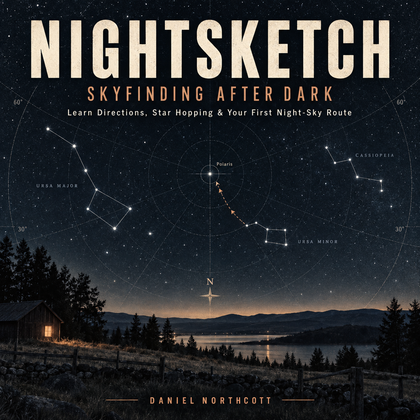
The Beginner Astronomy Library
- Skyfinding After Dark78 pp.
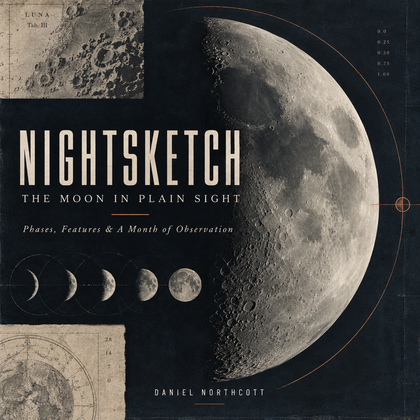
- The Moon in Plain Sight84 pp.
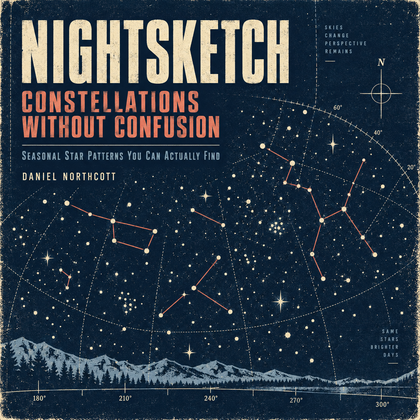
- Constellations Without Confusion92 pp.
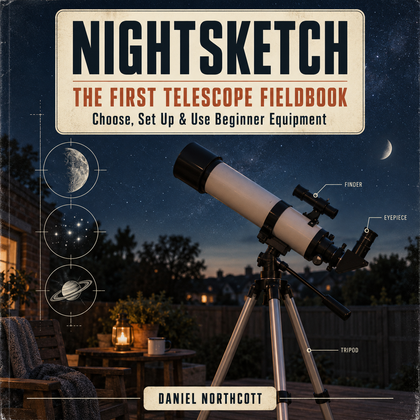
- The First Telescope Fieldbook88 pp.
$71.96£59.99
Get the Complete LibraryDigital product. No physical item will be shipped.
Home/Guides/Skyfinding After Dark
Learn Directions, Star Hopping & Your First Night-Sky Route
Turn an overwhelming sky into a short sequence of recognisable directions, shapes and star hops.
Format Digital PDF Planned length 78 pages Framed for Northern mid-latitudes Shipping Nothing shipped
About the guide
Learn how to orient yourself after dark, begin with reliable anchor stars and build a simple sky route you can repeat instead of trying to memorise everything at once.
The night sky feels complicated when every point of light appears equally important. Skyfinding After Dark gives you a calmer place to begin: understand what the sky is doing, find the cardinal directions, choose one bright anchor and move outward in short steps.
Rather than asking you to memorise a whole chart, the guide helps you build one repeatable observing route and record what changes. It also explains how darkness, weather, season, latitude and local light affect what you can see. The result is a practical first framework for looking up with purpose.
What you will learn
- How apparent sky movement affects an observing session
- How to protect dark adaptation and prepare a viewing spot
- How to find cardinal directions without relying on guesswork
- How to use bright anchor stars and simple patterns
- How star hopping works
- How to build and repeat a first observing route
- How to record conditions and observations
Contents
- 01What the Sky Is Doingp. 4
- 02Prepare for a Darker Viewp. 12
- 03Find the Cardinal Directionsp. 22
- 04Use Bright Anchor Starsp. 32
- 05Learn the Logic of Star Hoppingp. 42
- 06Build a First Night Routep. 52
- 07Record What You Noticep. 62
- 08Repeat the Route in a New Seasonp. 70
Page numbers refer to the planned 78-page edition.
Look inside
Short explanations, clear sequences, seasonal routes, safety notes and practical recording prompts.

Cover

Contents preview

Sample page
These are previews of the editorial style. They are not the complete ebook.
Who this is for
Complete adult beginners observing with the naked eye from the UK or similar northern mid-latitudes.
This is recreational astronomy for complete beginners. It is not professional scientific instruction, and it does not replace the manufacturer’s instructions for any equipment.
Protect your eyes. Respect the place.
Observe only from safe, permitted locations. Avoid roads, unstable ground and restricted property, prepare for weather and cold, and preserve night vision without creating trip hazards. What you can see depends on latitude, season, date, time, weather, local horizon and light pollution, so check current local sky information.
Digital product
Digital product. No physical item will be shipped. After purchase you should receive downloadable PDF file(s) through the store’s configured digital-delivery app. Device compatibility, download limits and refund terms follow the store’s published settings and policy.
Questions
Are these guides suitable for complete beginners?
Yes. They are written for adults starting recreational astronomy. They are not professional scientific training or an alternative to equipment instructions.
Are these physical books?
No. They are digital PDF guides. No physical product is shipped.
Do I need a telescope?
No. The first three guides can begin with your eyes or ordinary binoculars where appropriate. Only The First Telescope Fieldbook focuses on telescope equipment.
Will I see every object shown?
No. Visibility depends on latitude, season, date, time, weather, local horizon, light pollution, eyesight and equipment.
Can I use a telescope or binoculars to look at the Sun?
Never use an optical instrument to look at the Sun unless correctly fitted purpose-built solar equipment is being used with appropriate expert instruction. An error can cause permanent eye damage.
Can I buy one guide separately?
Yes. Each guide is available on its own, and the complete library brings all four together.
What format will I receive?
Downloadable PDF file(s) through the store’s configured delivery system once the final ebooks are available.
What is the refund policy?
Digital products are covered by the store’s refund policy, shown in full before checkout. Please read it on the policy page linked in the footer.
The other guides
Skyfinding After Dark
You are here
The Moon in Plain Sight
84 planned pages
Constellations Without Confusion
92 planned pages
The First Telescope Fieldbook
88 planned pages